These records are found in the online catalog of The Mariners’ Museum and Park in Newport News, Virginia. Uncurated search results are presented to give researchers and interested readers an idea of whether the museum’s archives contain information about this vessel and whether it may be worthwhile to visit the museum’s catalog search page for further investigation. Uncurated results may be inaccurate or incomplete.
Mariners Museum online catalog search, July 12, 2026. Search phrase: "Sea Gull". Catalog returned 16 records; this selection table includes 16 records fetched through catalog result pages.
Use these buttons to send uncurated search results to your own app or text document for further research. First, check the box for any row, or click "Select All" then uncheck any rows. Then click "Show Selections". You can then copy your selections from the text box and past them into your app.
On negative envelope: Schooner in Eastern Bay (near Tilghman's Pt, Md.) with cabin dory Sea Gull, smallest of 3 cabin cruisers owned by Percy E. Budlong, c. July 30, 1925
Starboard side view of unidentified schooner; the Sea Gull is coming alongside of it. Image from Cruises, Volume XXXVII, page 58-59.
Steamboats–United States.; Paddle steamers–United States.; Steam yachts–United States.
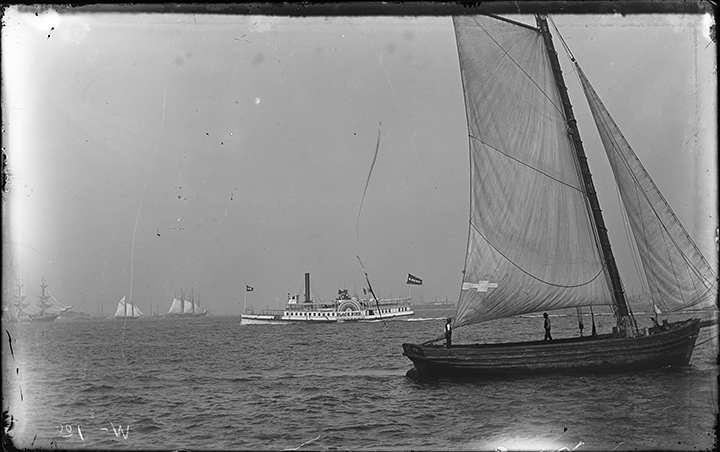
Shows a port side view of a side wheel steamer making way, passengers can be seen throughout her decks. In the background a steam yacht can just be seen. Stanton's notebooks contain the following information about this item: "Oct 3 1901"
BLACK BIRD (SIDE-WHEEL STEAMBOAT: 1864-1900); GALAFRE (SIDE-WHEEL STEAMBOAT: 1864-?)
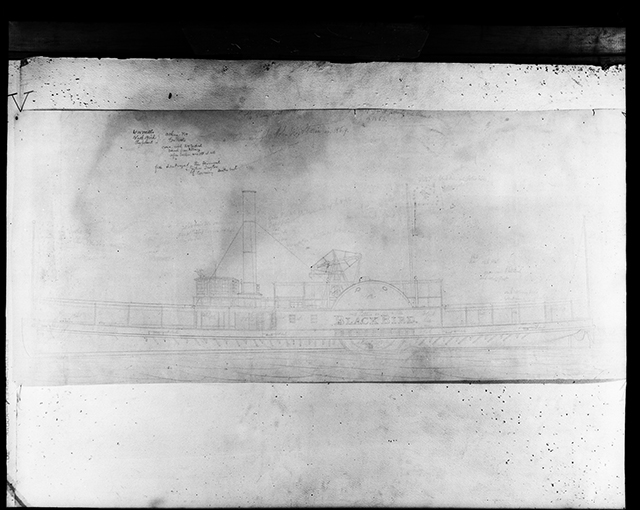
SHORT DESCRIPTION: Pencil drawing with color notes. (Note on print) The figure on Circle, is Representing Neptune Riding in a Car as a large Shell Reddish inside and White outside. The Head and Face is turned to the Bow and the 2 Horse also the sea is very ruff. He Has a Mantel a Flying Back from his Shoulders and lower limbs. he Stands in the Attitude of Holding the Thunder Bolt in His Hand, and a Streak of Lightning just by the Bolts. NOTES: Q 100 and Q 120 are on the same piece of paper. Q 100 is on the front side of the page and Q 120 on the backside of page. VESSEL INFORMATION - VESSEL NAME: GALAFRE VESSEL BUILT: 1864 VESSEL HISTORY: Spanish paddle side-wheel steamboat built in United States for Cuban service. she was of the typical type of steamer of the late 1860’s and early 1870’s. Note: This sketch is reproduced as Plate 35 (p.119) in Carl D. Lane, “American Paddle Steamboats” (1943). NOTES: Carl D. Lane. American Paddle Steamboats, 1943, Plate 35 GALAFRE A preliminary sketch, made from measures and drawn to scale, by James Bard. Upon a second visit to the subject with the sketch, additional notes were made and colors noted for the actual painting. One notation states: "42 holes in bulwark," this referring to the free ports in the guard strake at the paddle box. Another (in Bard’s own spelling) states: The figure on Circle, is Representing Neptune Riding in a Car as a large Shell Reddish inside and White outside. The Head and Face is turned to the Bow and the 2 Horse also the sea is very ruff. He Has a Mantel a Flying Back from his Shoulders and lower limbs. He stands in the Attitude of Holding the Thunder Bolt in His Hand, and a Streak of Lightning just by the Bolts. All steamboats were painted by Bard only after such detailed and careful notes, and his paintings are accepted as authentic by steamboat historians and students. The GALAFRE was built in the United States in the late sixties and was in Cuban service under the Spanish flag. NOTES: Q 120 INSCRIPTION: BLACKBIRD (on paddle box and flag); The steamboat BLACK BIRD owned by Garret Winant and Overend (?) in 1863. Owned by John H. Starin in 1869. H.W. WELLS, BLACK BIRD, OLYPHANT, Athens, N.Y. towboats. Conn. with N.Y. Central Branch from Albany before bridge was blt. at Alb. Fire destroyed the terminal and JOHN TAYLOR, E. CORNING sister boat. NOTES: Pencil drawing with color notes. GALAFRE, Q 100 on reverse side. VESSEL INFORMATION - VESSEL NAME: BLACK BIRD VESSEL HISTORY: American wooden paddle side-wheel steamboat built by B. C. Terry at Keyport, NJ, in 1863-4. she was 150 feet 3 inches long, breadth of 25 feet 9 inches, and depth of 8 feet 9 inches, gross tonnage of 365. She was constructed for Garret Winant, and in 1869 was owned by John H. Starin. She later became the SEA GULL, and in 1913 was known as the APOLLO, and was still in service as late as 1926. As the APOLLO she was owned by Victor Von Schoeler of New Orleans. Her name does not appear in the 1927 register, when she was broken up. The steamboat BLACK BIRD owned by John H. Starin 1869. H. W. Wells, BLACKBIRD, OLYPHANT, Athens, NY towboats. 1900 rebuilt at Noank, CT, as the SEA GULL, 1910 McAllister Steamboat Co.’s APOLLO 1913 taken to Mobile, AL. Alternate vessel names: (1) BLACK BIRD (1864-1900); (2) SEA GULL (1900-1910); (3) APOLLO (1910-1927).
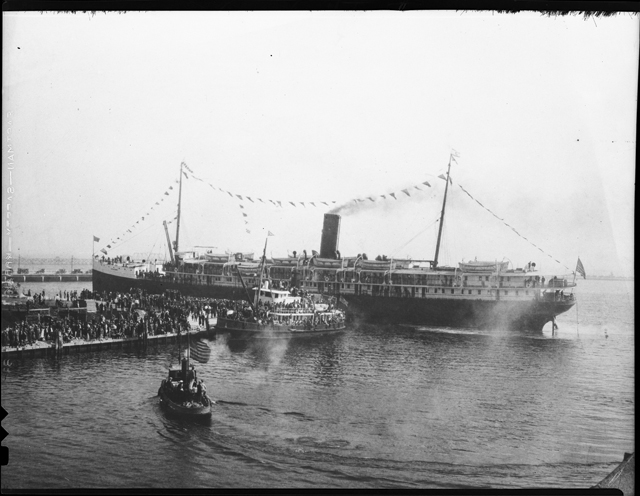
Apollo, built in 1864. Formerly known as the Black Bird and the Sea Gull. Photograph taken on July 5th, 1916.
Shows portside view of the Apollo with the name written on the side. Another steamship is visible in the top left corner and smaller boats along the bottom frame. Inscription on bottom reads "Dry Dock Blown Two Miles Up Mobile River".
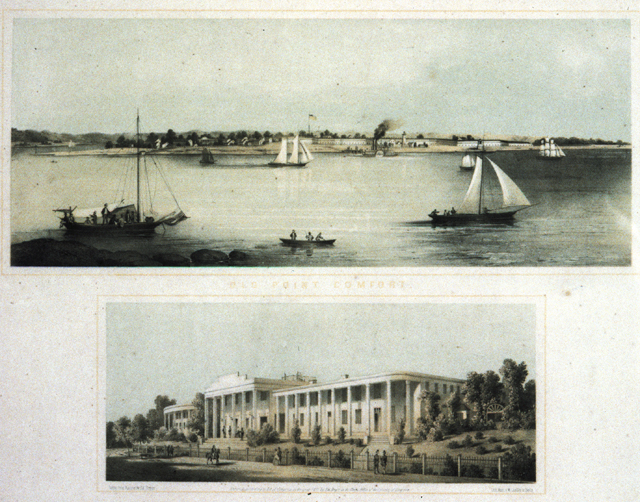
CURATORS NOTES: R. Jones, 2/3/2000... From "An Album of Virginia" An Album of Virginia: A series of prints showing ante-bellum Virginia (and present day West Virginia) as drawn by Edward Beyer. The scenes show the Virginia countryside and spas just before the Civil War, and they nicely evoke this bucolic period of the south. The natural wonders, famous resorts and important sites throughout the state are depicted with a great detail, and rendered precisely by the expert German lithograph firms. There are 40 plates in all, this is Plate 35. Edward Beyer was born in Germany in 1820 and studied art in Dusseldorf and worked in Dresden during the 1840’s. He traveled to America about 1848. Possibly he emigrated with other liberal Europeans amid the revolutions of 1848-1849, for his collaboration with another European expatriate, Beyer soon undertook a panoramic depiction of the "Wars for Liberty" in Rome, Northern Italy, and Hungry – a huge work said to have had spectacular landscapes and more than ninety thousand figures – which was exhibited in Philadelphia, New York and Cincinnati early in the 1850’s. In 1856, after spending two years traveling, sketching and painting throughout Virginia, Beyer announced his plans to issue his Virginia works in an album of lithographs. On 19 of May, 1856, the Richmond Dispatch reported that he had met "with considerable success in obtaining subscriptions to his Virginia scenes." By 1857. The artist had returned to Germany to oversee the printing of his lithographs at Berlin and Dresden. Copies of the forty color plates and illustrated title page, were shipped to Richmond, where the Album of Virginia was entered for copyright in 1858. Beyer’s lithographs were printed in three colors (generally black, blue and yellow). Two of the Virginia State Library’s three copies of the Album, are in this state: the third copy, was also hand colored. Although, the Album contained no written descriptions except for the titles on the plates, a separate Description of the Album of Virginia: or The Old Dominion, Illustrated was printed by the Enquirer Book and Job Printing Office and issued in two pamphlets in 1857 and 1858. The text of these pamphlets reprinted by the Virginia State Library in 1980, is thought to be the work of Samuel Mordecai, whose Richmond By-Gone Days: Being Reminiscences of An Old Citizen had appeared in its anonymous first edition in 1856. Many of Mordecai’s descriptions of scenes and incidents in the Description of the Album of Virginia, closely parallel passages in Henry Howes, Historical Collections in Virginia. John Kukla, An Album of Virginia, Preface. Richmond: Virginia State Library, 1980. Samuel Mordedai, Description of the Album of Virginia, Plate 32. Old Point Comfort It Situated in Elizabeth City County, at the mouth of James River, 12 miles in a direct line from Norfolk. The name was given to it in the year 1607 by the first Colonists of Virginia, on account of the good channel and safe anchorage it afforded. Fortress Monroe is built on Old Point Comfort; and this is one of the largest single fortifications in the world, and is generally garrisoned by a regiment of the United States troops. The officers quarters occupy neat and tasteful buildings within the fort, where there is a fine level parade ground, ornamented by live oak. When the bar is passed, the harbor affords one of the finest anchorage’s, in which navies could ride in safety up to Norfolk and City Point. The view from the Fort is lovely and interesting. Steamers and sail vessels are continually passing, with colors flying and canvas spread, while the sea gull, with its white wing, follows "in the wake." A pure, health giving sea breeze makes it, even in the sultry days of summer, delightfully pleasant. Near the Fort is the large Hygeia Hotel to which visitors flock every season either for health or pleasure. Besides the fine bathing establishments, there are pistol galleries, bowling saloons, and comfortable boats for fishing parties. Hampton, which was the scene of British wrong and cruelty in the war of 1812, is two and a half miles from Point Comfort. 1. Natural Bridge LP 887 2. Harpers Ferry 3. Rockfish Gap 4. High Bridge 5. Weyer’s Cave 6. Stribling’s Springs 7. Burner’s White Sulphur 8. Montgomery White Sulphur 9. Peaks of Otter 10. Peaks of Otter 11. The Hawk’s Nest 12. The Little Tunnel 13. Old Sweet Springs 14. Rockbridge Alum 15. Yellow Sulphur Springs 16. Blue Sulphur Springs 17. Falling Springs 18. Gamble’s Hill LP 5054 19. Bullard Rock 20. Four Views of Weyer’s Cave 21. Salt Sulphur 22. Red Sulphur 23. Salt Pond 24. Salt Pond 25. Natural Bridge (from above) 26. Kanawha Falls 27. Harper’s Ferry 28. Troy Run Viaduct (On Cheat River B. & O.R.R.) 29. Greenbrier White Sulphur LP 8868 30. Fauguier White Sulphur 31. Hot Springs 32. Old Point Comfort LP 34 33. Little Sewell Mountain 34. Little Sewell Mountain 35. James River Canal 36. Natural Bridge (From a Distance)LP 888 37. View of the Peaks of Otter 38. Roanoke Red Sulphur 39. Red Sweet 40. Warm Springs
SPRINGFIELD - MASSACHUSETTS - UNITED STATES - Manufacturer; CABOTVILLE - MASSACHUSETTS - UNITED STATES - Manufacturer
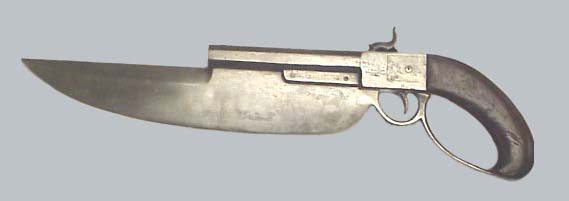
SHORT DESCRIPTION: Elgin patent percussion cutlass pistol made by the Cyrus B. Allen company of Springfield, Massachusetts and the Ames Manufacturing Company in 1837. The gun, serial number 5, is marked “Elgins Patent” and “CBA” for maker Cyrus B. Allen of Springfield, Massachusetts. Other marks on the top of the gun are “PM”, the initials of the US Inspector of Contract Arms, and the date “1837”. The number “5” is stamped on the blade and side of the barrel. The pistol has a 5-inch, smoothbore, octagonal barrel and a rounded trigger guard. The 11-inch bowie-knife blade is attached to the bottom of the gun barrel and points forward so that the pistol handle also serves as the knife handle. The top edge of the cutlass is beveled. The pistol has an elongated finger guard that stretches from the trigger guard to the wooden butt. NOTES: The Bowie-knife became popular after James Bowie’s Sandbar Fight in 1827 on the Mississippi River near Natchez. During the fight Bowie was stabbed and shot twice but still managed to kill Norris Wright, the Sheriff of Rapides Parish, with a large knife. Bowie then reinforced his fame by dying at the Alamo in 1836, reputedly still with his knife in his hand. On July 5, 1837, New York’s George Elgin patented his pistol-knife or pistol-cutlass, a combination of two weapons a single-shot pistol and a knife or cutlass in a single weapon. Elgin cutlass pistols were manufactured by Cyrus B. Allen of Springfield, Massachusetts and Morrill, Mosman & Blair of Amherst, Massachusetts. The pistols made for civilian sale varied in size from .35 to .41-caliber and were usually fitted with rifled or smoothbore barrels 4 to 5 inches long and knife blades 7-1/2 to 10-1/2 inches long. The Ames Manufacturing Company in Cabotville made the blades for the C.B. Allen pistols. Elgin believed that the combination of pistol and cutlass would better arm sailors for battle and marketed the weapon to the US Navy. In 1838, the US Navy purchased 150 .54-caliber cutlass pistols for use in the U.S. Exploring Expedition (also called the Wilkes Expedition and South Seas Exploring Expedition). The guns had 5-inch smoothbore octagonal barrels and 11-inch blades, with an overall dimension of 17 inches. The pistol had an elongated finger guard that stretched from the trigger guard to the butt. The Elgin cutlass-pistol was the first official percussion handgun used by the US Military and was the only combination gun ever issued to US military servicemen. NOTES: Originally authorized in 1828, the US Exploring Expedition was composed of six vessels, with a complement of scientists, under the command of Lt. Charles Wilkes. The expedition left Hampton Roads, Virginia on August 18, 1838. It landed at Madeira before rounding South America touching at several locations. It then proceeded to the South Pacific where it explored numerous islands including Tahiti, Samoa, New South Wales and Sydney, Australia. The expedition then sailed in the Antarctic Ocean and explored the Antarctic continent charting 1500 miles of coastline. The expedition proceeded back to the South Pacific and explored Tonga, Nuku'alofa and Fiji where members of the crew encountered hostile natives at Malolo. Several Americans and about eighty Fijians were killed. On the expedition's return it explored the west coast of the United States, continued to explore a number of Pacific islands before heading back to the US by way of the Cape of Good Hope. Nineteen scientific volumes were published after the fleets return and the expedition played a major contribution in the advancement of the U.S. scientific community. This weapon is mentioned several times in the expedition's narrative, which is titled "Narrative of the United States exploring expedition. During the years 1838, 1839, 1840, 1841, 1842." The only time the weapon was used in anger is on page 270 of Volume III: While on the island of Malolo in Fiji, the Americans encountered hostile natives. When a landing party was attacked on the beach, Midshipman Wilkes Henry pursued a native and cut him down with his "bowie-knife pistol." Henry then shot another native just as he was struck with a club on the back of his head and killed. On page 187 in Volume V: While a party from the expedition was exploring the Sacramento river they camped with some indians. The next morning "when the party were breaking up camp to embark, an Indian boldly seized the bowie-knife-pistol of Dr. [Charles] Pickering” [a naturalist with the expedition] and escaped into the woods. On page 338-339 in Volume V: While the expedition was at Jolo (Wilkes calls it 'Sooloo') in the Philippines, Mr. James D. Dana, the mineralogist with the expedition "had for a moment laid down [his bowie-knife] on a chest" while in the governor's house. Wilkes concluded that it had been stolen and determined to the governor responsible for the theft, stating that the pistol must be returned before the next morning or he must face the consequences. That evening Wilkes ordered one of the long guns to be fired towards the town “believing that the sound and reverberation alone would suffice to intimidate such robbers.” The gun’s report “fairly shook the island” and Wilkes was sure the gun would be returned the next day. At daybreak Wilkes was informed by a special messenger from the governor that the pistol had been found and would be returned without delay. NOTES: Excerpts from blog post “Ames Manufacturing Company, Chicopee, Mass” by Derek Strahan, published on July 12, 2018 on Lostnewengland.com and from “The Ames Century, 1829-1929” published in Man at Arms in November/December 1980. In 1829 industrialist Edmund Dwight persuaded brothers Nathan Peabody (1804-1847) and James Tyler Ames (1810-1883) to relocate their cutlery business from Chelmsford to Chicopee Falls, Massachusetts. By 1833 the Ames company had expanded and was producing a wide variety of cutlery and tools and swords for the Army and Navy. In 1834 the company was incorporated as the Ames Manufacturing Company. In 1835 the company moved downriver to Cabotville, a village that would later become the center of Chicopee when it was incorporated as a separate town in 1848. In 1836 a bronze foundry was established in which cannon and sword parts could be cast. The Ames Manufacturing Company pioneered electro-plating in America in the late 1830s. The company continued to grow and by the late 1830s was also producing cannons, cannonballs, bells and a variety of other metal objects. In the 1840s, an expansion of its facility was earmarked for the production of arms for the Navy; a breech-loading carbine designed by William Jenks and a box-lock percussion pistol. The corporation divested itself of the Jenks contract in 1849. In the 1840s and 1860s, the company provided munitions to the government. In June 1861 Ames received contracts for 17,000 swords (10,000 cavalry sabres; 5,000 artillery sabres; 1,000 artillery swords; 3,000 NCO swords; 3,000 musician swords; 1,500 mounted officer swords; 3,000 foot officer swords; and 300 staff officer swords). Another flood of contracts followed eventually amounting to 154,224 swords by the end of the war (34% of the Ordnance Officer sword purchases from 1861-1865). Also produced were bronze howitzers, heavy iron siege and coastal defense guns, coehorn mortars and a variety of ordnance projectiles. Nathan died in 1847 but James remained with the company until his retirement in 1872. While the Civil War had been a boon for business, afterwards the company struggled to adapt to peacetime demands. The company produced a wide array of metal products and in the 1870s had major foreign contracts for bayonets, scabbards and sabers. The company continued to decline and in 1908 the factory complex was sold to A. G. Spalding and Brothers, a sporting goods company established by Albert G. Spalding.

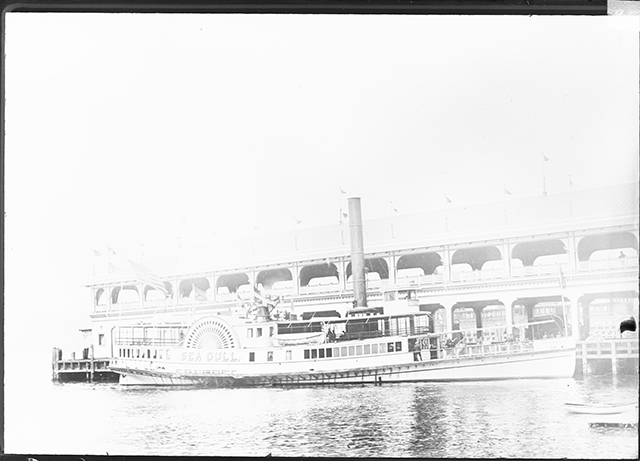 MS0095-1161
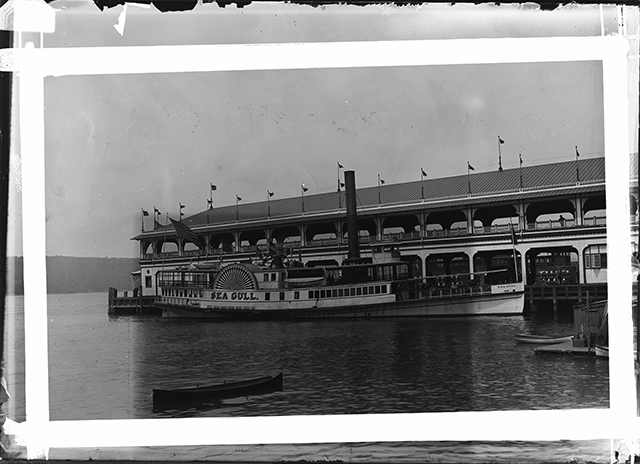 MS0095-1162
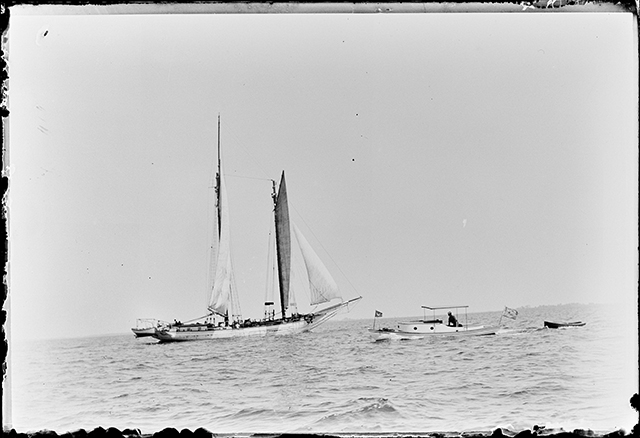 P0026-011
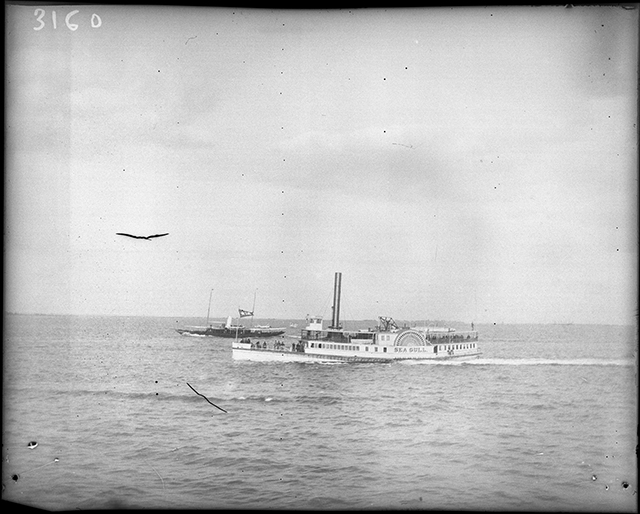 MS0094-3160 Sea Gull
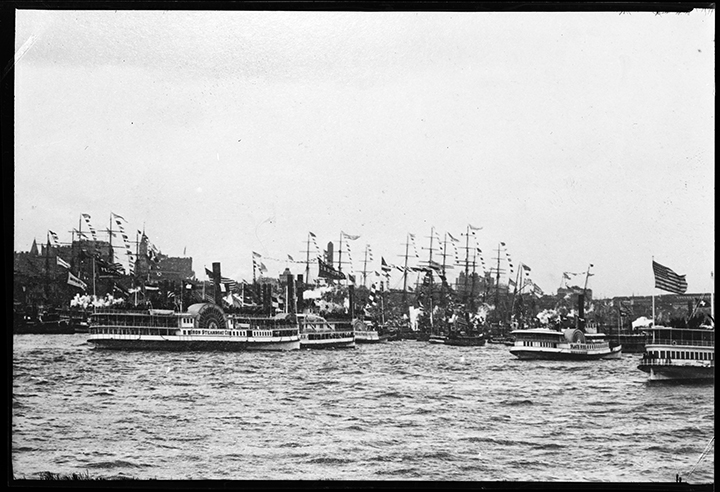 MS0091-03-01-43-065
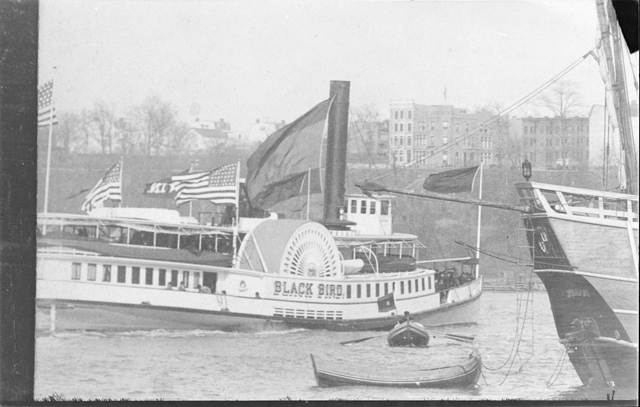 MS0091-03-01-06-073
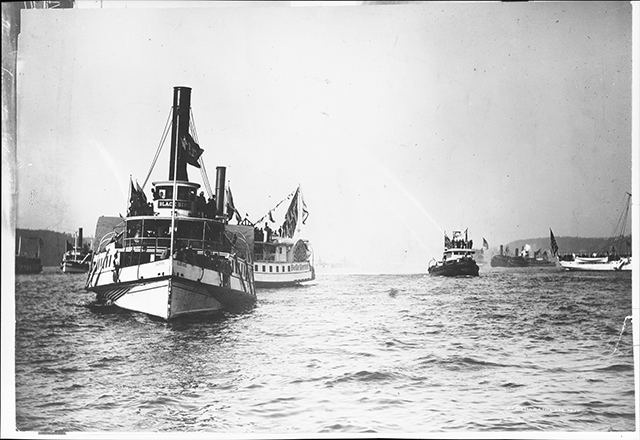 MS0091-03-02-0263
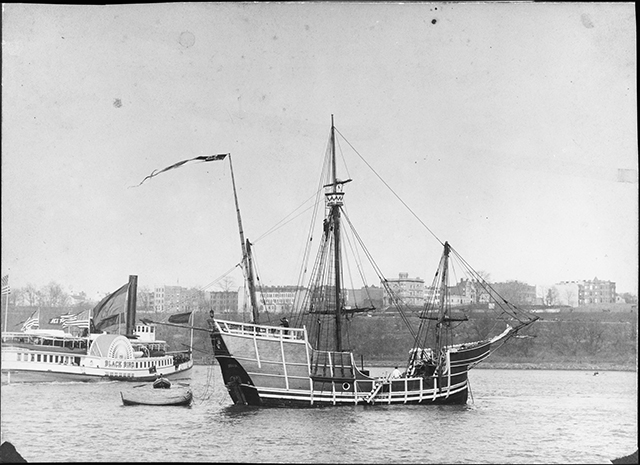 MS0091-03-02-0264
 MS0091-03-03-014
 MS0091-03-02-0265
 MS0091-03-01-03-085
 1934.1155.000001
 Full-size image